

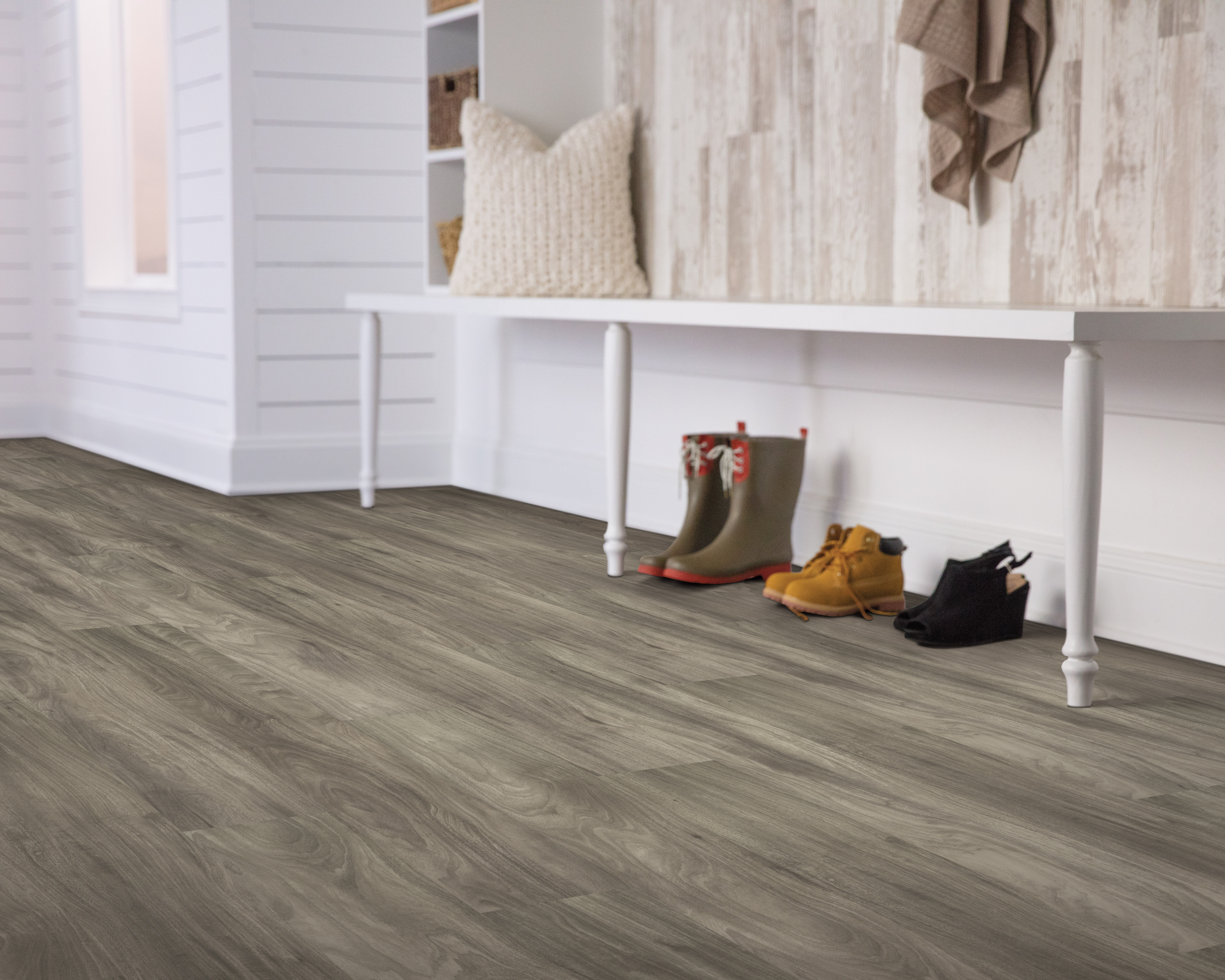
You can put paint on a luxury vinyl floor, but it usually peels or wears through, and the reason is baked into the material. A luxury vinyl plank is finished with a hard, smooth, stain-resistant top layer, and that same slick surface is exactly what paint cannot grip. Some homeowners get a year or two out of a careful paint job in a low-traffic spot; most end up scrubbing flakes out of a doorway. Here's the science of why paint struggles on vinyl, whether staining works any better, how to give paint its best shot if you're set on it, and when a new floor is the smarter spend.
Can You Paint Luxury Vinyl Plank Floors?
You can apply paint to luxury vinyl, but you are working against the floor's design, so the result rarely lasts. Painting a porous surface like bare wood lets the paint soak in and lock on; luxury vinyl is the opposite, a sealed plastic surface, a clear wear layer just a fraction of a millimeter thick, about 0.2 to 0.7 mm, over a factory-cured urethane coat, built to shed spills and resist stains. The paint sits on top with little to hold it, so foot traffic, cleaning, and the small flex of a floating floor all work it loose over time. It is doable as a short-term refresh, but it is not a durable finish, and knowing why comes down to how surfaces and coatings actually bond.
Why Paint Struggles to Stick to Luxury Vinyl
Paint struggles on luxury vinyl because the floor's surface energy is too low for the paint to wet out and grip. Surface energy is the property that decides whether a liquid spreads into a surface or beads up on it. The plastic a vinyl floor is made of, PVC, has a fairly low surface energy, measured at about 44 millinewtons per meter, and the clear, factory-cured coating on top is smoother and lower still. That is great for wiping up spaghetti sauce and terrible for holding paint.
The rule that governs it is simple. For a coating to bond, the surface it goes onto has to have a higher surface energy than the liquid's own surface tension, or the coating cannot spread out and make real contact. It is the reason paint grips bare aluminum, which has high surface energy, and beads on a slick plastic, which does not. Adhesives engineers state it plainly: good wetting is what makes a good bond, and a low-energy surface does not give you good wetting.
Materials research backs up the mechanism. When scientists tested a plastic composite surface in a 2018 study in the journal Polymers, they found its adhesion was poor because the surface was dominated by low-energy, non-polar plastic. Only after a treatment lifted its surface energy from about 39 to 68 millijoules per square meter did a coating hold, and the peel strength nearly doubled, from 56 to 102 newtons per meter. A factory floor plank gets no such treatment on your subfloor, so a coat of ordinary paint is starting from the losing side of that equation.
Can You Stain Luxury Vinyl Instead?
Staining luxury vinyl does not work the way staining wood does, because stain needs a porous surface to soak into and vinyl has none. Wood stain colors a floor by penetrating the grain; a luxury vinyl plank is sealed plastic with a printed design under a clear wear layer, so a stain has nothing to sink into and simply sits on the surface like a thin, fragile paint. If you want a different color, changing the plank gives you a real, embedded design instead of a coating waiting to wear off. The printed layer is the color, and it is protected in a way a surface stain never will be.
If You Still Want to Paint It: How to Give It the Best Shot
If you're set on painting a vinyl floor, the whole game is forcing an unwilling surface to hold a coating, and preparation is everything. Paint made to grip slick, non-porous surfaces calls for the same sequence every time: clean off every trace of grease and cleaner, dry it fully, and dull the factory sheen so there is some texture for the coating to key into. Skip any of that and the paint fails faster.
From there, a bonding primer is the part people leave out and regret. A bonding primer is a specialty primer formulated to grip glossy, low-energy surfaces that ordinary primer slides off, and it is the layer standing between your color coat and the vinyl. Over it goes a floor-grade enamel built to take foot traffic, left to cure fully, and finished with a clear floor sealer for whatever extra life you can buy. Even done right, expect the finish to show wear first at seams, pivot points, and doorways, where flex and traffic concentrate, and plan to touch it up. Think of it as a refresh with a shelf life.
How Painting a Floor Affects Your Indoor Air
Painting a floor adds volatile organic compounds to the air in the room, while a certified new plank is tested to limit them. The U.S. Environmental Protection Agency (EPA), the federal agency that tracks indoor air quality, notes that paints and floor coatings contain organic solvents that release these compounds, known as VOCs, and that indoor levels of many run up to ten times higher than outdoors, spiking during and after a project. A finished luxury vinyl plank can go the other way: many carry FloorScore certification, an independent mark run by the certifier SCS Global Services with the Resilient Floor Covering Institute (RFCI), which tests the product against California's indoor-air rules for emissions of 35 individual volatile organic compounds. One approach adds solvents to your home; the other has been screened to limit them.
When New Flooring Beats Painting
New flooring beats painting whenever you want the result to last, which for a floor is most of the time. Paint is a reasonable stopgap if you are selling soon, testing a color, or refreshing a closet nobody walks through. For a kitchen, an entry, or any room that sees daily life, the money and weekend a paint job costs are better put toward a floor that already has the color and durability built in. If your current vinyl still has life in it and you just want it looking fresh, cleaning it correctly often does more than paint would, and we walk through that in our guide to cleaning luxury vinyl the right way. If it's time for a real change, a new floor from our luxury vinyl collection gives you a color that will not peel.
Questions We Get About Painting Vinyl Floors
Will painted vinyl flooring peel?
Painted vinyl flooring usually does peel or wear through eventually, because the paint is bonded to a surface engineered to resist it. Thorough prep and a bonding primer slow it down, but the low surface energy of the vinyl means the coating never grips the way it would on a porous floor. Peeling shows up first where the floor flexes and gets the most traffic.
How long does painted vinyl flooring last?
A carefully painted vinyl floor typically holds up for a year or two in a low-traffic room, and far less in a busy one. The lifespan depends almost entirely on prep, the products used, and how hard the room gets used. Because the result is temporary, painting makes the most sense as a short-term fix rather than a lasting finish.
Is painting vinyl plank different from painting sheet vinyl or vinyl tile?
All of them share the same obstacle, a sealed, low-energy surface that resists coatings, so the prep and the limits are similar across vinyl plank, sheet vinyl, and vinyl tile. Tile and plank add the extra challenge of seams, where paint tends to crack and lift first. None of the three takes and holds paint the way a porous wood or concrete floor does.
Is there a low-VOC way to refresh a vinyl floor?
The lowest-VOC refresh is usually not paint at all: a proper deep clean restores most of a tired vinyl floor's look without adding solvents to your home. When a floor is genuinely worn out, replacing it with a FloorScore-certified plank keeps indoor emissions low while giving you a finish that lasts. Both beat sealing the room in fresh paint fumes.
Thinking About Refreshing Your Floors?
Painting luxury vinyl is one of those projects that looks easy and disappoints slowly, and the material is the reason. As a family-owned company with over 50 years in flooring across the Harrisburg and greater Charlotte area, we would rather tell you honestly when a clean-up will do and when a new floor is the better spend than sell you a finish that peels. When you want to weigh the options, request a free in-home estimate and we will look at your floors and talk through what actually lasts.


